
From nanomaterials and synthesis to CRISPR-Cas9, nano medicine, energy, and computational simulation — a complete program covering the full breadth of nano science and its real-world applications.
Six core domains — from nanomaterials and synthesis to real-world applications across electronics, medicine, energy, and environment.
Carbon nanotubes, graphene, metal nanoparticles, quantum dots, and nanocomposites — understanding nanoscale properties and why they matter.
FoundationTop-down and bottom-up approaches, Chemical Vapor Deposition (CVD), sol-gel method, and ball milling for creating nanomaterials.
Core skillSEM, TEM, AFM, XRD, and UV-Visible spectroscopy — instruments used to observe, measure, and validate nanoscale structures.
In demandNano-transistors, flexible electronics, drug delivery systems, cancer therapy, nano solar cells, Li-ion batteries, and supercapacitors.
Applied scienceClean room standards, lithography, thin film deposition, etching, nano robots, self-healing materials, and shape memory alloys.
AdvancedNano simulation tools, molecular modeling basics, Density Functional Theory (DFT), and MATLAB/Python for nanotechnology research.
Cutting edge12 modules across materials, fabrication, applications, and computation — from clean room practice to molecular simulation.
This course follows Skillumni's industry-aligned Nano Science & Nanotechnology curriculum. You begin with the definition, scope, and history of nanotechnology, then build understanding of nanoscale fundamentals and why nano-sized materials behave so differently from their bulk counterparts.
You then progress through types of nanomaterials (CNTs, graphene, quantum dots), synthesis routes (CVD, sol-gel, ball milling), and characterization techniques (SEM, TEM, AFM, XRD). The applied modules cover four major sectors — electronics, medicine, energy, and environmental engineering — before advancing to nano fabrication (lithography, etching, clean rooms), smart materials, and nano robotics. The course culminates in computational nanotechnology using molecular modeling and MATLAB/Python, and a capstone project with industry exposure, research review, and career guidance.
Three stages, twelve modules, one pathway from nanoscale fundamentals to industry-ready research skills. Tap a module to expand it.
Two industry-recognised credentials awarded on successful completion.
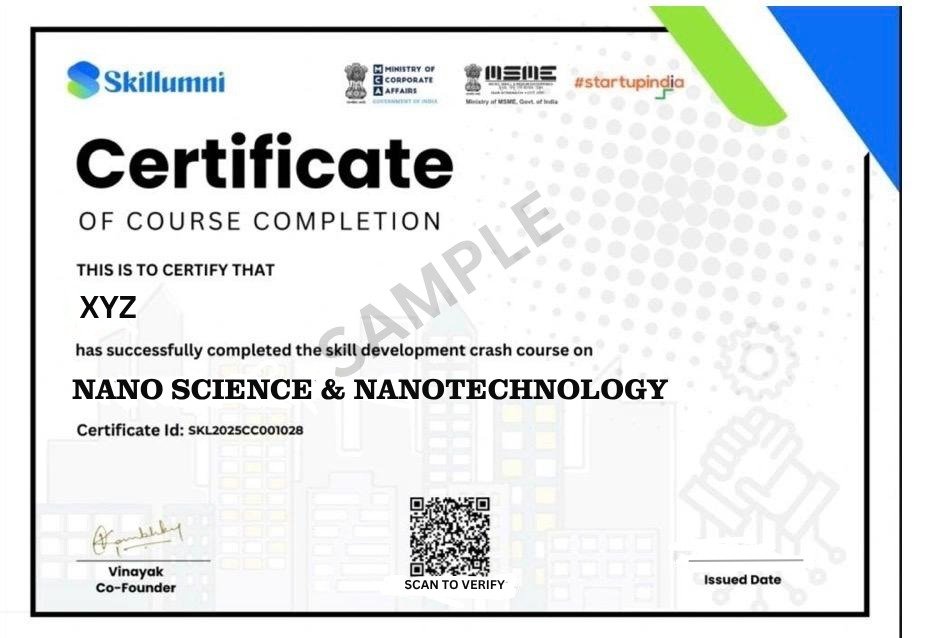
Proof of your nanotechnology skills after you finish all 12 modules.
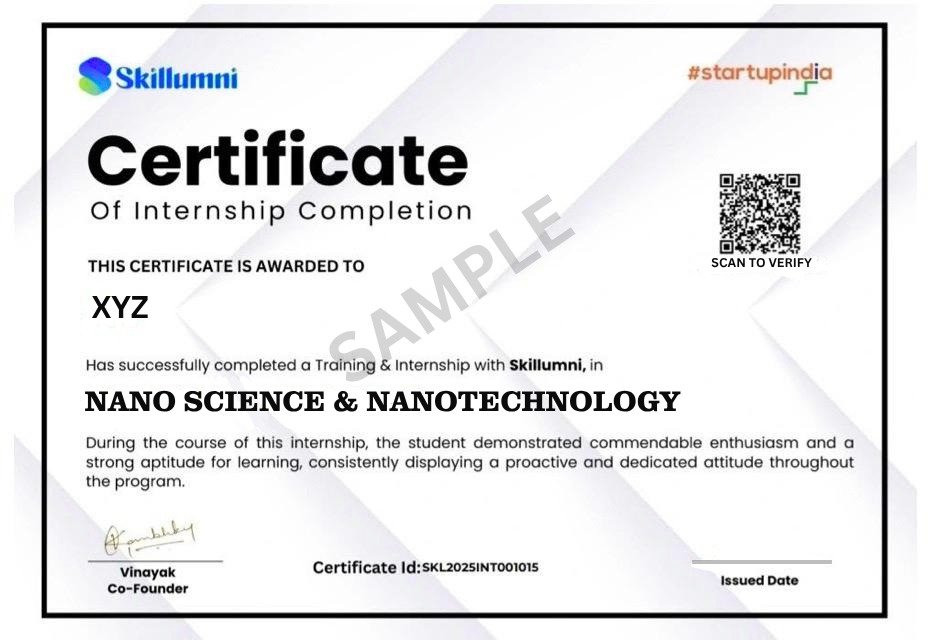
Proof of real project experience from your live projects and capstone.
Everything you need to enter nanotechnology and materials science professionally.
Built on Skillumni's structured nano science curriculum — from CNTs and synthesis to clean room fabrication, simulation, and career readiness.
Real project development, research paper reviews, industry case studies, and viva — portfolio-ready outcomes for R&D and engineering roles.
Course Completion + Internship Certificate — credentials recognised in R&D labs, materials engineering, pharma, and electronics companies.
A star-rated, personalised Letter of Recommendation based on your project work and performance — valued by hiring managers in science and engineering.
Direct access to nanoscience and materials engineering professionals for doubt clearing, project guidance, and career advice throughout.
Placement assistance and referrals to our network of R&D labs, biotech firms, electronics companies, and materials science organisations.
Pick the learning style that suits you — both include dual certification and placement support.
Secure payment · Instant access
Secure payment · Instant access
Nano Science & Nanotechnology
100% secure payment · Instant confirmation